
Introduction to Spline 3D : A Complete Training Journey from Fundamentals to Real-World Applications


Getting Started with Spline 3D
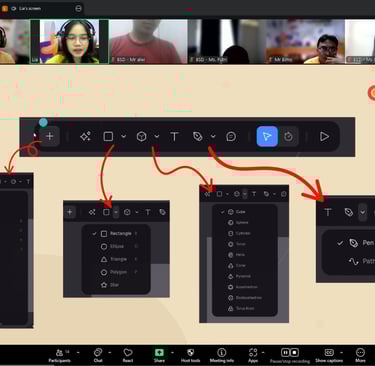
The training opened with a walkthrough of the Spline 3D interface, showcasing its browser-based environment and ease of access. Participants quickly realized that no heavy installations were required, making it ideal for learners at all levels. The session emphasized the importance of understanding the workspace layout, navigation tools, and the creative possibilities that Spline offers.
Spline 3D is a mathematical construct widely used in computer graphics, animation, and CAD (Computer-Aided Design). This technique allows for smooth, flexible curves to be created by defining a series of points in 3D space. By connecting these points with polynomial functions, splines enable designers to create complex shapes and surfaces that are both aesthetically pleasing and functional.
Understanding Objects and Basic Manipulation
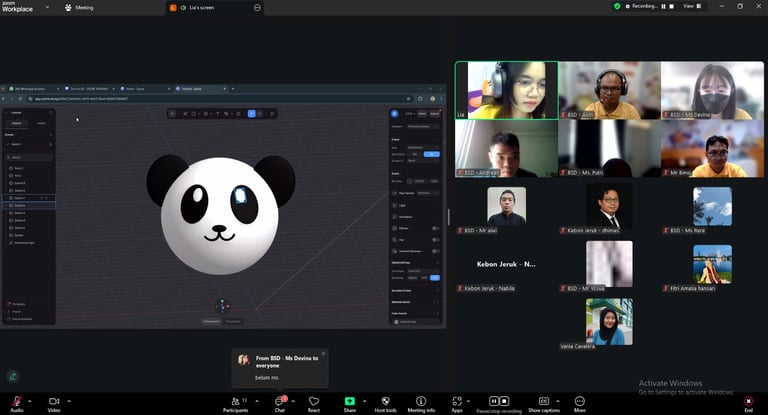
The second stage focused on building simple 3D objects and learning essential manipulation tools. Attendees practiced scaling, rotating, and positioning objects to form basic compositions. This segment laid the foundation for mastering object control, showing how simple shapes could evolve into more complex structures with just a few adjustments.
In the industry, Spline 3D finds applications in various fields including animation, automotive design, and architectural modeling. For instance, in animation, character designers utilize splines to create smooth movements and realistic graphics. In automotive design, splines are essential for crafting the sleek shapes of vehicles, enhancing both aerodynamics and visual appeal. Similarly, architects use splines to design intricate building structures that require precision.
Customizing Materials and Textures
Once participants became comfortable with objects, the session introduced the art of applying materials and textures. Trainers guided learners through color palettes, gradients, and realistic finishes that enhanced visual storytelling. The ability to customize surfaces opened up discussions on brand identity, product design, and artistic expression within 3D environments.
The mathematics behind Spline 3D involves a blend of calculus and linear algebra. The fundamental principle of splines is based on piecewise polynomial functions that are defined in segments, allowing for continuous derivatives. This results in smooth transitions between points. The most common types of splines used include linear, quadratic, and cubic splines, each varying in complexity and application.
Mastering Lights and Shadows
Lighting became the next focus area, teaching participants how to create atmosphere and depth in their designs. By experimenting with spotlights, ambient light, and shadows, attendees learned how illumination transforms flat designs into immersive 3D scenes. This hands-on practice highlighted the role of lighting in influencing mood and visual impact.
There are several techniques within Spline 3D, including Bézier splines, B-splines, and NURBS (Non-Uniform Rational B-Splines). Bézier splines are particularly renowned for their use in graphic design applications due to their intuitive control points. B-splines offer greater flexibility and are useful in computer-aided geometric design, while NURBS provide a powerful method for defining both standard and freeform shapes.
Creating a Spline 3D Model: A Step-by-Step Guide
To create a Spline 3D model, designers typically follow a systematic approach. This begins with defining control points that outline the desired shape. Next, the spline function is applied to connect these points, ensuring continuity and smoothness. Once the initial shape is crafted, further refinements can be made, including the adjustment of weights and knots to enhance the curve’s characteristics.
One of the most exciting parts of the training was learning to add interactivity and motion. Trainers demonstrated how to animate objects and integrate simple interactive elements, enabling participants to make their 3D designs more engaging. The session illustrated how movement and responsiveness can capture attention and enhance storytelling in digital spaces.
Exporting and Integrating into Web Projects
While the use of Spline 3D offers numerous advantages, several challenges can arise during the design process. Issues such as over-fitting and complexity can lead to visually unsatisfactory results. Designers must strike a balance between control and flexibility, ensuring that the final product is not only accurate but also optimal in its shape and form.
With designs taking shape, participants were introduced to Spline’s export features. The training showed how to embed projects into websites or share them across platforms. By understanding integration methods, attendees gained insight into how Spline bridges the gap between creativity and practical applications in professional design projects.
Real-World Applications and Future Opportunities
The training concluded by connecting the technical skills with real-world opportunities. Examples included interactive product showcases, immersive educational tools, and innovative marketing campaigns. Trainers emphasized that learning Spline 3D is not just about mastering a tool—it is about unlocking future-ready skills that combine design, technology, and storytelling.
Looking ahead, the advancements in computational techniques and algorithms are paving the way for more sophisticated applications of Spline 3D. As industries continue to push the boundaries of design and innovation, the role of splines in creating prototypes, visualizations, and interactive models is expected to expand significantly. Embracing these developments will be critical for designers and engineers alike.







Contact Us
info@makereducation.id
+62 822 9943 1484







© PT DIGIKIDZ INDONESIA
MAKER Education Group 2026